



<img height="1" width="1" style="display:none" src="https://www.facebook.com/tr?id=301879849994395&amp;ev=PageView&amp;noscript=1">

Blog

See the latest news, innovation updates, trial results, grower stories and more from Agricen. 
July 25, 2022 — Posted By Agricen

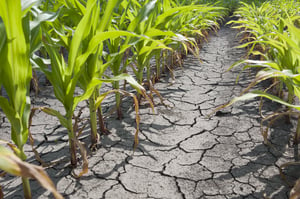
droughtDrought stress can cause significant yield reductions in corn, so it's important for growers to proactively consider ways they can reduce the impact of dry conditions on their crops.

Although growers can't control the weather, they do have options that can help them improve plant health and strengthen their corn crop's stress tolerance in the face of drought.

What Options Do Corn Growers Have for Combating Drought Stress?

Approaches for combatting the effects of drought or dry conditions include:

  • Strobilurin-containing fungicides.
    Strobilurin-containing fungicides have known beneficial effects on corn development, even in the absence of disease.

  • Foliar nutritionals.
    Foliar nutritionals can be added to fungicide applications for even stronger plant health effects. Nutrient absorption in the leaf tissue is highly efficient and can partially make up for shortfalls in root absorption when the soil is dry. In addition, applying relatively small amounts of foliar nutritionals can prompt plants to work harder at extracting nutrients from the soil and can increase drought tolerance.

  • Foliar- or soil-applied biostimulants, biologicals or plant hormone technologies.
    Products in this category can stimulate the plant and/or soil microbes to improve crop tolerance to drought stress and allow energy to go into yield, rather than stress response.

One product in the last category is TERRAMAR, available from Nutrien Ag Solutions. TERRAMAR is designed to improve both nutrient uptake and plant response to weather-related stress, including drought or dry conditions. It can be applied in season to help corn stand up to drought and heat stress.

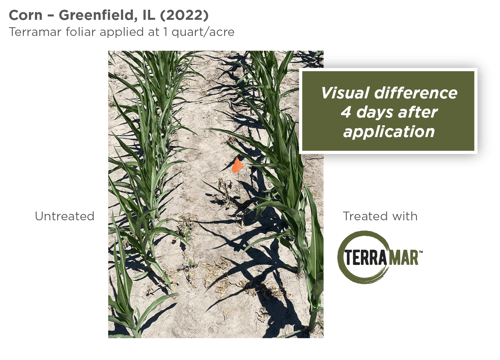
In a field trial from Illinois (photo below), TERRAMAR was foliar-applied on V5 corn experiencing heat and drought stress. Only four days later, the treated corn looked visibly healthier.
Terramar-corn 01

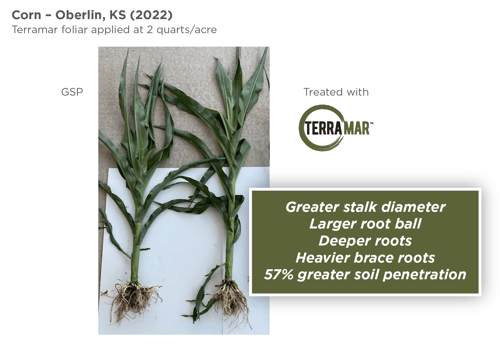
A field trial from Kansas (photo below) also shows a visual improvement with foliar-applied TERRAMAR on 12-leaf corn that was experiencing both drought and heat stress. The benefits can be seen both above and below the soil, with a healthier looking plant that has a greater stalk diameter, larger root ball, deeper roots, and heavier brace roots.
Terramar-corn 02

What's more, the TERRAMAR-treated plants had 57% greater soil penetration, pulling at the 55-cm level on the water probe measurement, compared to the untreated plants that were not yet pulling at even the 45-cm level when measurements were taken.

With many areas of the nation experiencing hot, dry weather, it's the right time to consider these tools as a way to potentially reduce the total impact of drought conditions.

Learn more about the benefits of the marine-based technology found in TERRAMAR by downloading the corn and soybean bulletin.

Download the Study


Read More
January 24, 2022 — Posted By Agricen

Although crops take up many salts in the form of nutrients, they can be adversely affected if more salt is added to the soil system than can be taken up by the plant or flushed out of the root zone. This is especially a concern in irrigated cropping systems, where dissolved salts from irrigation water can lead to soil salinity problems that compound over time. Salts in applied fertilizers can also contribute to soil salinity.

Soils that are high in salts can limit water uptake, impede nutrient uptake, and negatively impact seed germination and crop development. Plants that do survive will exhibit less vigor, have slower physiological development and show signs of stress, preventing full yield potential from being realized. Taking steps to manage soil salinity is therefore critical to having balanced soil for optimal plant growth and productivity.

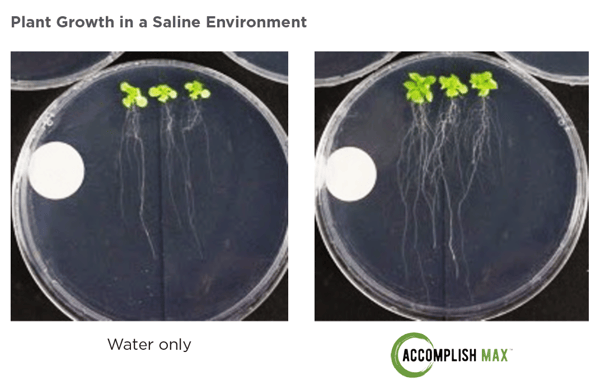
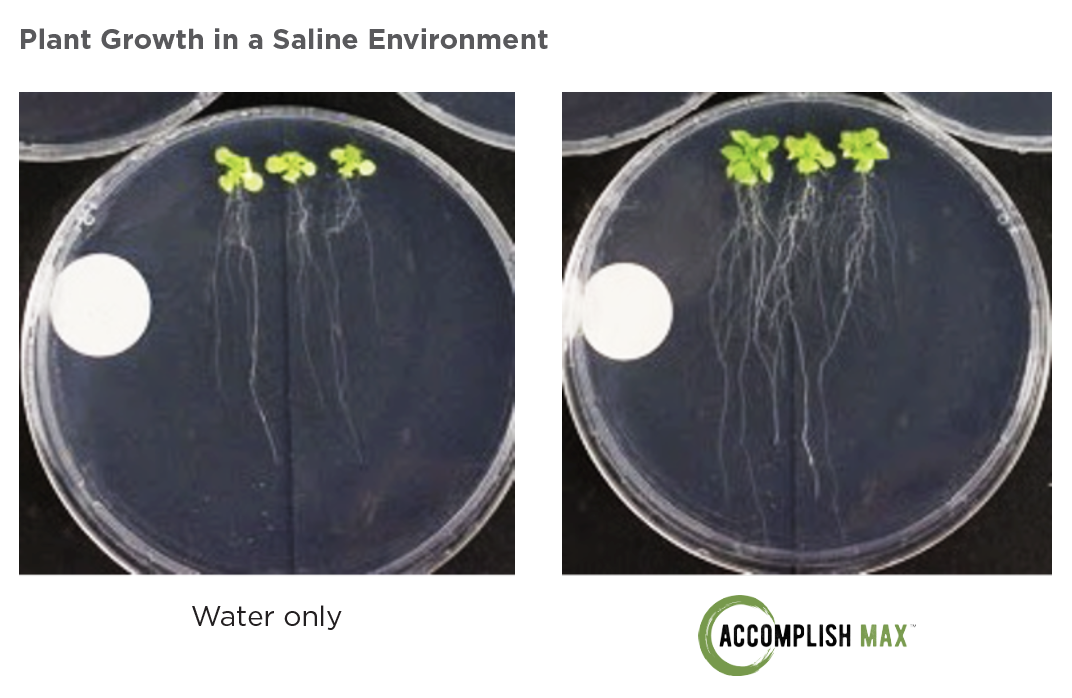
ACCOMPLISH MAX, which is available through Nutrien Ag Solutions, is a next-generation biocatalyst designed to help plants better tolerate salt and other abiotic stresses.01-21 Accomplish Max saline environmentPlant germinated in presence of 120 mM salt, with and without ACCOMPLISH MAX. Images were taken 10 days after treatment. Note longer roots, more vigorous plant with ACCOMPLISH MAX.

ACCOMPLISH MAX mitigates salt stress with a three-pronged effect:

  • Frees up calcium from soil chemistry, which allows sodium to be displaced from the exchange site and flushed from the root zone.
  • Encourages plants to uptake additional potassium, which increases the K+/Na++ ratio to offset the toxic effects of sodium.
  • Breaks soluble salts apart, thereby lowering electrical conductivity.

Recommended for use in liquid starter applications, ACCOMPLISH MAX contains biochemistry proven to increase nutrient availability in the soil combined with a highly soluble kelp-based extract to increase crop tolerance to abiotic stresses like salinity from applied fertilizers. ACCOMPLISH MAX can be an important addition to any fertility or management program for crops affected by salt stress.

Download the ACCOMPLISH MAX salt stress bulletin.

Download the Bulletin


Read More
April 6, 2020 — Posted By Agricen

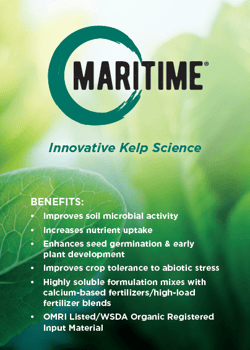
Maritime Educator ImageMARITIME® improves nutrient uptake and plant functioning to give growers unmatched seed germination, plant growth, nutrient uptake and resistance to abiotic stress. It can be used to enhance crop growth and performance both under positive growing conditions and under stress conditions from environmental factors such as drought, heat or salinity.

The MARITIME products booklet covers:

  • Product benefits
  • How MARITIME works
  • Trial results in specialty crops, including lettuce, peppers, and celery
  • Uses and rates

What is MARITIME?

MARITIME is a highly soluble solution of biologically converted kelp that can be used by growers to augment a balanced crop nutrition system. MARITIME stimulates soil microbiota, improves plant growth, and reduces crop stress for better crop quality and yield.

MARITIME is OMRI listed and is a WSDA Organic Registered Input Material

Learn more about MARITIME kelp technology for agriculture by downloading the digital booklet.

Access the Maritime Booklet

Read More