



 More than three million acres of row crops across America have been treated with TERRAMAR during the 2026 growing season—and new availability in both Canada and Australia means that many more growers now have access to this unique foliar technology.
In this interview with WITY Radio, Agricen’s Scott Lay discusses why TERRAMAR has been so successful and how it fits with late-season fungicide applications in corn and soybeans.
Dennis Michelsen – WITY Radio: Tell us why TERRAMAR should be in our game plan.
Scott Lay - Agricen: TERRAMAR is a very effective tool that can be used early post with herbicides, during reproductive-phase fungicide applications, or both. It has proven consistent in its ability to minimize the impact of weather-induced stress—which at this time of year is often related to heat and or drought—and in its ability to increase nutrient flow into the plant, resulting in more sucrose being made by the plant, which can ultimately lead to more yield.
Dennis – WITY Radio: It pays to take extra care, because every time the plant is in stress, that's when we lose yield.
Scott - Agricen: That's right. Anything we can do to create a more desirable environment for the crop or to optimize crop functioning, such as by improving water use efficiency, lowering canopy temperatures, or increasing the amount of photosynthesis or sugars produced—all of which TERRAMAR does—translates to the potential for greater yield when the combine rolls through the field in the fall.
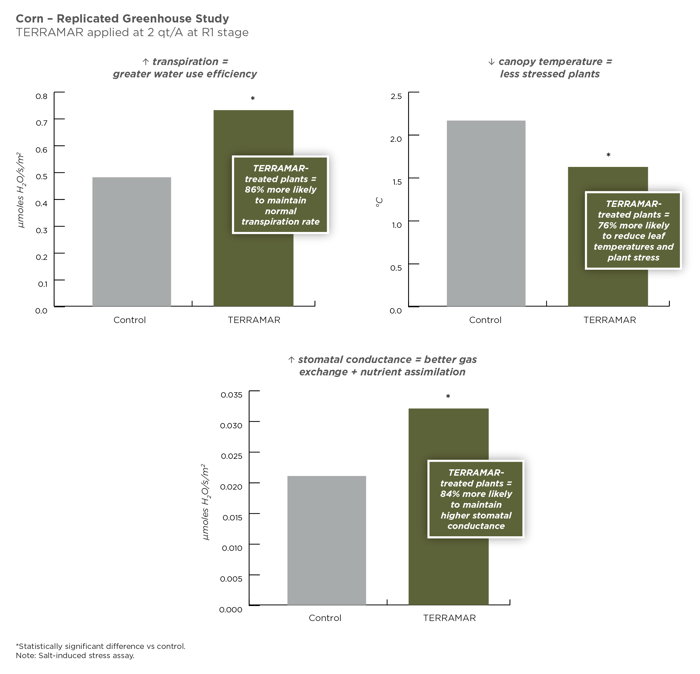
In the greenhouse study above, a foliar application of TERRAMAR improved water use efficiency,
kept plants cooler, and improved gas exchange and nutrient assimilation, all of which illustrate more optimal plant functioning that can push a crop towards a more positive yield outcome.
Dennis – WITY Radio: And TERRAMAR rides along just fine with other products that growers are applying at this time of the year.
Scott - Agricen: Yes. With the amount of precipitation and humidity we’ve had, there's been a high potential for disease presence in both corn and soybeans. A lot of growers have been making the decision to apply a fungicide to help manage the impact of disease in their crop. TERRAMAR is a great companion for that fungicide application. Obviously it doesn't control diseases because it’s not a fungicide itself, but if you can have a stronger plant with more photosynthesis and more water moving through that plant due to an application of TERRAMAR, it's a tougher environment for those diseases to expand and flourish.
Dennis – WITY Radio: How is TERRAMAR working in the field? What are the differences we notice?
Scott - Agricen: We'll start with the differences in the plants. In as little as three to five days after application, there's a noticeable difference in plant growth and in plant greening. That ties back to the photosynthesis that is occurring with greater efficiency. There's more water transpiration and more sugars surging through that plant. And that translates to a healthier, more robust plant visually.
If we transition to later in the season, even before the combines run, TERRAMAR is preserving more kernel mass in corn and soybean seed size is larger because the plant has more nutrients to fill that grain or pod. That's what translates to the yield. TERRAMAR is positively impacting the plant throughout the course of the growing season so that more yield is preserved. I think that’s really the story of TERRAMAR.
Dennis – WITY Radio: Right now, corn and soybean prices are down. The only way to do better with low prices is to grow more crop.
Scott – Agricen: The average yield advantage with TERRAMAR over hundreds of different split field trials in corn is about +7.5 bu/A. In soybeans, it’s about +4.5 bu/A. That’s for an investment of about $8 per acre for the grower. So the economics stack up favorably.
Now, commodity prices aren't where any of us would like. But we're not going to save our way to prosperity. If we make selective investments in practices that are going to provide a high likelihood of return, that's how we get ahead over time.
Dennis – WITY Radio: And it's not just about the average increase in yield. It's the percent of wins that you have in these trials.
Scott – Agricen: That’s right. There’s a strong change of a net positive economic return. We see that almost 90 percent of the time. So it seems like an investment worth making as you consider whether TERRAMAR should be a part of those summer fungicide applications.
Learn more about using TERRAMAR with fungicide applications by downloading the FAQ.