



<img height="1" width="1" style="display:none" src="https://www.facebook.com/tr?id=301879849994395&amp;ev=PageView&amp;noscript=1">

Blog

See the latest news, innovation updates, trial results, grower stories and more from Agricen. 
June 4, 2026 — Posted By Agricen

As yield increases, so does crop residue volume, particularly in corn. Excess post-harvest residue presents challenges on any farm, especially in reduced till or no-till environments. Come spring, three of the main issues farmers with excess residue can face are:

  • Lower soil temperatures: This is particularly problematic as soybean planting dates are pushed earlier.
  • Excess moisture: Residue retains moisture and can delay planting.
  • Delayed emergence: Residue on top of the row of planted soybeans can decrease seed to soil contact and delay emergence.

One way to tackle this challenge is with an application of EXTRACT, which can be broadcast on crop residue in the fall after harvest or in the spring prior to planting to enhance residue decomposition. The newest version, EXTRACT XC, is concentrated for easy handling in the field.

Extract Residue Decomp_Tanner_AndrewTanner Evenstad (pictured on left), who farms in Belmont, Wisconsin, worked with his Loveland Products agronomist Andrew Tucker (pictured right) in the fall of 2025 to apply EXTRACT on his corn stalks as part of a residue management trial. Taking a look at his field in late April, he could see a significant difference where EXTRACT was applied.

Where it wasn’t applied, that’s where the residue wasn’t broken down nearly as much, and it was a little bit harder to dig the seed,” Tanner explains. “You could tell that the areas treated with EXTRACT were better.”

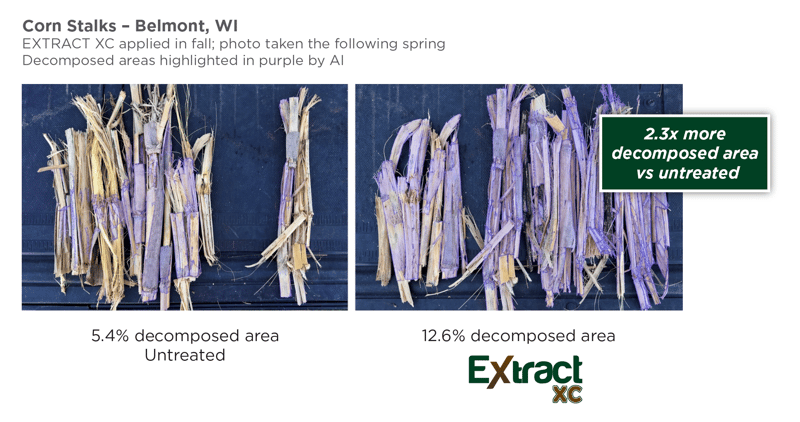
Andrew and Tanner also used AI to help them compare some of the corn stalks from the treated and untreated areas. Looking at their samples, they found that stalks pulled from the EXTRACT-treated field had 2.3x more area showing decomposition compared to untreated stalks.

06-26 Extract XC Corn-Residue Decomp-blog

For decomposition analysis, the image was converted to grayscale, then artificial intelligence (AI) was used to apply an automatic threshold to highlight decomposition-associated areas. AI detected and highlighted decomposition in 5.4% of the area in untreated stalks compared to 12.6% of the area in stalks treated with EXTRACT.
One of the advantages of EXTRACT is that the key component driving its residue breakdown capabilities is not live microbes, but rather the metabolites that microbes make naturally, which is captured during the manufacturing process. It is these metabolites that do the heavy lifting of helping to turn residue from last season into plant-available nutrients this season, while also increasing the rate of nutrient mineralization in the soil profile.

This means that farmers don’t have to wait for their soil microbes to “wake up” in the spring to start the process of residue breakdown and nutrient mineralization. Instead, EXTRACT gives them a head start, since the microbial metabolites in the product are active even under cool conditions.

This not only increases nutrient availability in the soil, it also offers the potential for earlier planting in the spring.

We’re able to get out to the field a little bit sooner with that residue decomposition from EXTRACT,” says Andrew. "We're really looking forward to doing tissue tests in season and seeing what extra nutrients we made available for the soybean crop this year."

Learn more by downloading the EXTRACT XC product booklet.

Read More
June 10, 2024 — Posted By Agricen

Wheat growers commonly apply fungicides to their crops to optimize plant health and yield. Typical application timings include early April after the flag leaves emerge (Feekes growth stage 9) and at heading shortly after (head scab application/Feekes growth stage 10.5.1). TERRAMAR can be utilized in the same pass as a wheat fungicide during any application timing, offering another stress-fighting and yield-enhancing tool to optimize crop yield potential.

What benefits can TERRAMAR add to a wheat fungicide application?

  • TERRAMAR minimizes the impact of weather-related stresses (e.g., cold and dry conditions) to help maintain normal physiological functions. 

  • TERRAMAR increases nutrient uptake and photosynthetic capacity at a critical time of yield determination.

Nutrien Ag Solutions has conducted multiple field trials in which TERRAMAR was applied at different stages of wheat growth with a fungicide. As seen in the examples below, consistent yield responses and a positive return on investment (ROI)* were observed across the different timings, whether one or multiple applications of TERRAMAR were made with the grower’s standard practice (GSP). 

FLAG LEAF/FEEKES 9 FUNGICIDE APPLICATION

05-24 Terramar-Wheat-Feekes 9

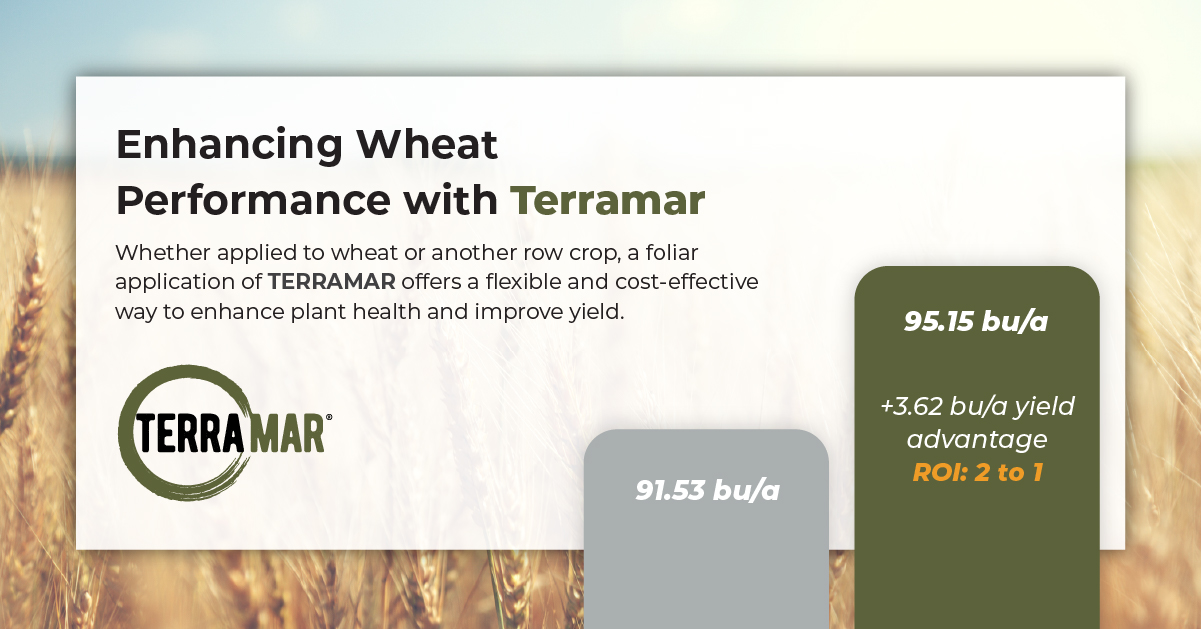
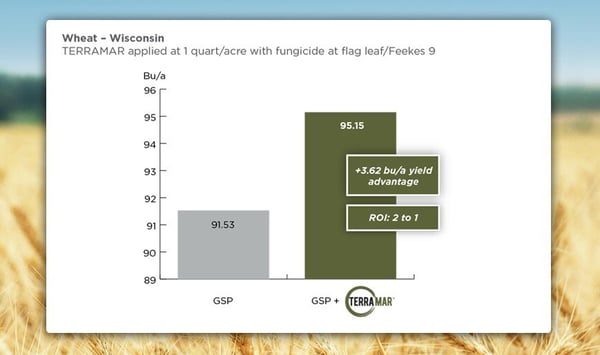
In a Wisconsin field trial, TERRAMAR was applied at 1 quart/acre with fungicide at the Feekes 9 growth stage (flag leaf). The addition of TERRAMAR to the grower's standard wheat fungicide program led to a +3.62 bu/a yield advantage compared to the fungicide alone, with an ROI of 2:1.

(If a flag leaf fungicide application is not being made, TERRAMAR is also compatible with herbicide applications made at Feekes 8.)

HEAD SCAB SPRAY/FEEKES 10.5.1 FUNGICIDE APPLICATION

05-24-Terramar-Wheat-head scab 2 plots

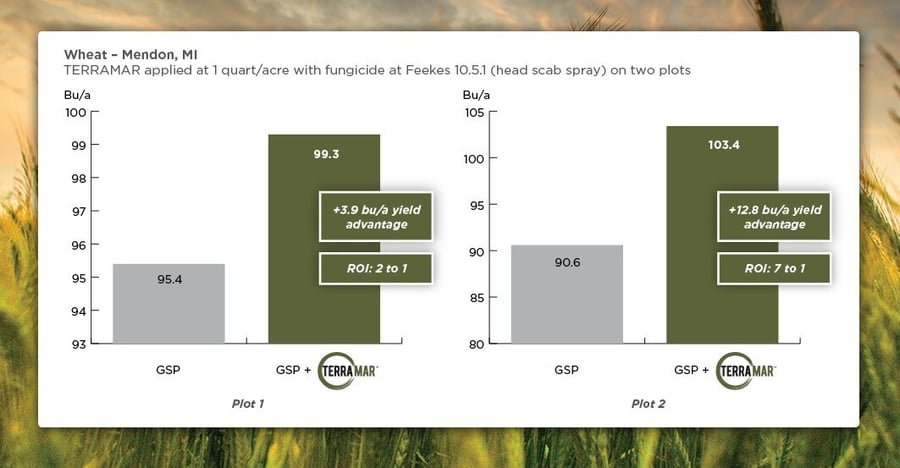
In a field trial in Michigan, adding TERRAMAR to the grower's head scab fungicide application led to a yield advantage that ranged from +3/9 bu/a (Plot 1, ROI of 2:1) to +12.8 bu/a (Plot 2, ROI of 7:1).

05-24-Terramar-Wheat-Head Scab Spray IN

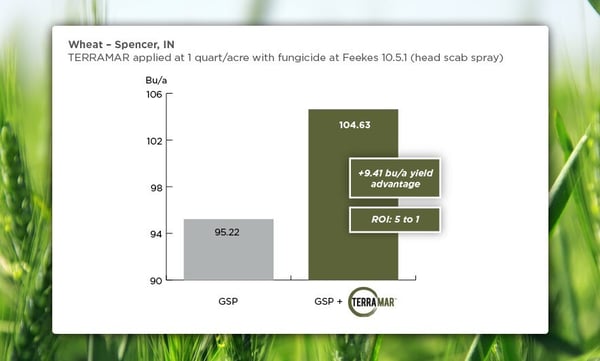
In an Indiana trial, the yield advantage when TERRAMAR was applied with a wheat head scab fungicide was +9.41 bu/a, with an ROI of 5:1 compared to the fungicide alone. 

05-24-Terramar-Wheat-Head Scab Spray OH

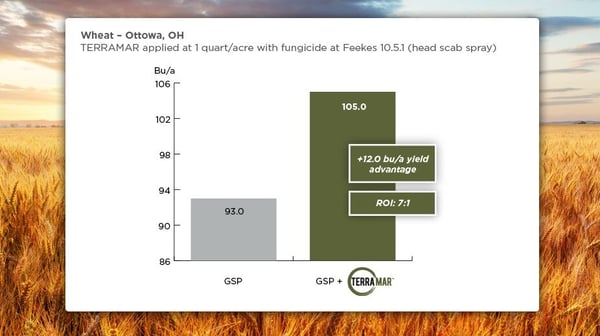
In Ohio, a yield advantage of +12.0 bu/a was seen when TERRAMAR was added to a wheat head scab fungicide application, with an ROI of 7:1 compared to the fungicide alone. 

FEEKES 8, 9 & 10.5.1 (3 APPLICATIONS)

05-24-Terramar-Wheat-3 Apps-PA

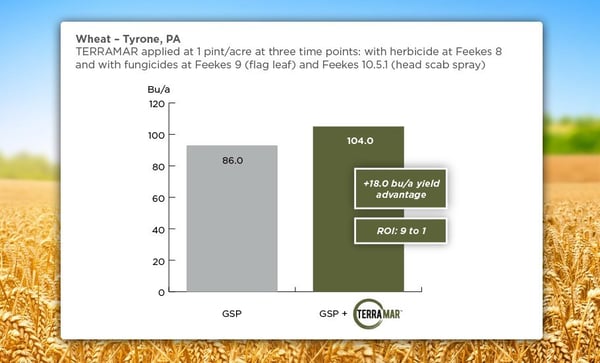
Lastly, a Pennsylvania field trial in wheat showed an +18.0 bu/a yield advantage when TERRAMAR was applied at 1 pint/acre at three time points: First with herbicide at Feekes 8, and then with fungicides at Feekes 9 (flag leaf) and Feekes 10.5.1 (head scab spray). The ROI in this trial was 9:1.

SUMMARY

Whether applied to wheat or another row crop, a foliar application of TERRAMAR offers a flexible and cost-effective way to enhance plant health and improve yield.

*ROI calculations assume wheat at $6/bushel.

View more wheat results by downloading the TERRAMAR Midwest wheat study.

Access the Study


Read More
July 5, 2023 — Posted By Agricen

Terramar Top 10Many agricultural areas across the United States are facing weather-related challenges, but there are still opportunities to make the most out of what Mother Nature is dishing out.
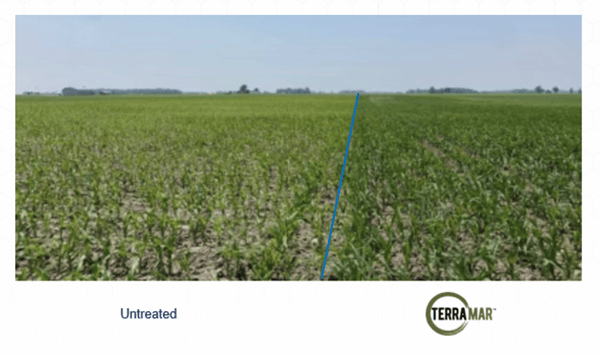
Terramar, a new product for row crops, is formulated to help crops stand up to abiotic stresses (such as heat and dry conditions) while also increasing nutrient uptake for better plant growth.

The photos below document the performance of Terramar applications made on corn, soybeans and wheat earlier this season, and they show some very strong visual results.

With another opportunity to apply Terramar now here (this time with fungicide or plant nutrition products on reproductive-stage corn and soybeans), we wanted to share these images as a reminder of the potential in this year's crop.

Here are the top 10 Terramar field pictures of 2023, so far:

1. Terramar on Corn – Ferris, Illinois

Terramar 1 Corn Ferris IL 2023 -1Dry conditions (No rain for 11-12 days). Terramar was applied at 1 pint/acre. Photos taken May 26, 2023, 8 days after application. 15 plants per bundle.

2. Terramar on Corn Muscoda, Wisconsin

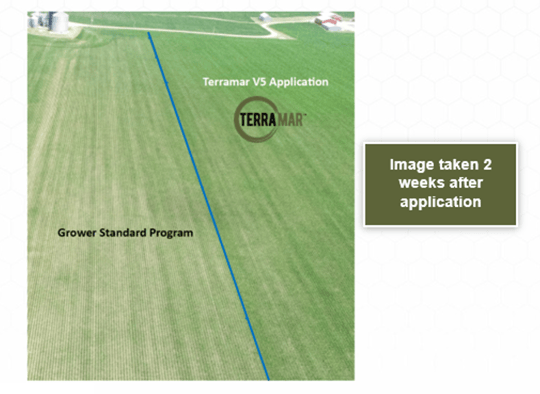
Terramar 2 Muscoda WI Corn 2023 -1Corn crop planted April 29, 2023. Dry conditions (2.2” precipitation since planting). Terramar was applied at 1 quart/acre at V5. Photo taken June 21, 2023, two weeks after Terramar application.

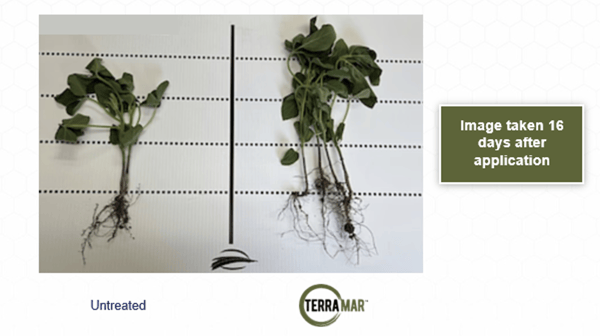
3. Terramar on Soybeans – Farmington, Illinois

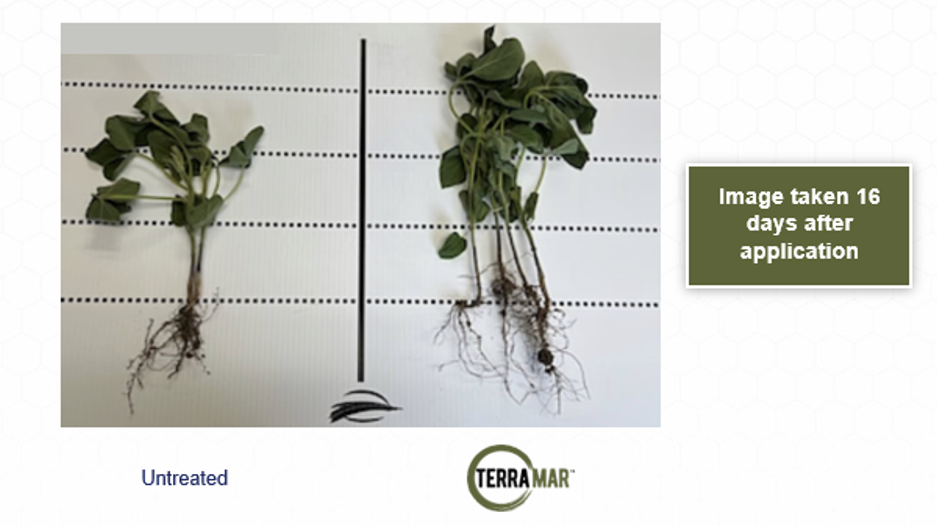
Terramar 3 Farmington IL Soybeans 2023Terramar was applied at 1 pint/acre on May 29, 2023. Photo taken 16 days after Terramar application. 

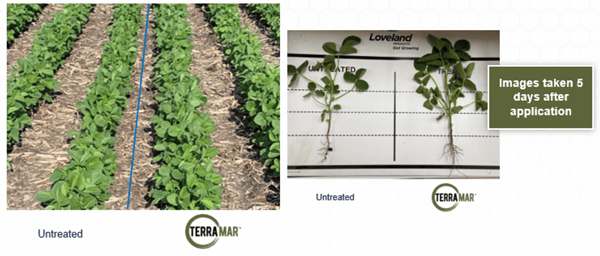
4. Terramar on Soybeans – East Chain, Minnesota

Terramar 4 East Chain MN Soybeans 2023Terramar was applied at 1 quart/acre. Photos taken 5 days after Terramar application. 

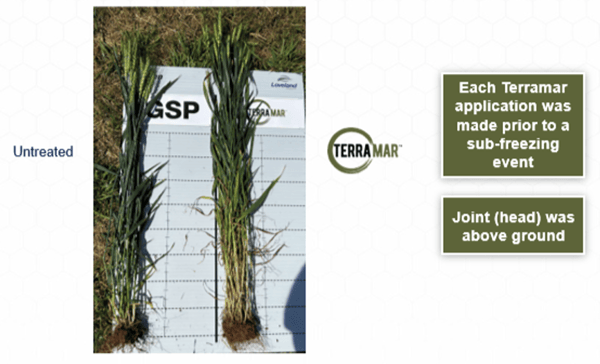
5. Terramar on Wheat – Kentucky

Terramar 5 Kentucky Wheat 2023

Terramar was applied twice, each time at 1 pint/acre prior to a sub-freezing event. Joint (head) was above ground. Photos taken mid-May.

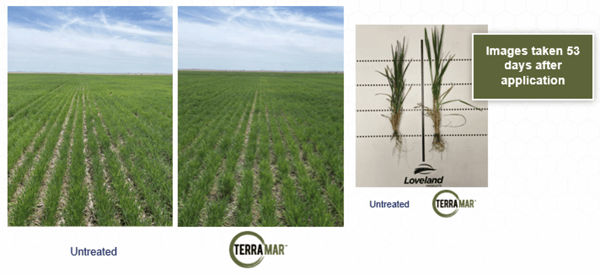
6. Terramar on Wheat – Oberlin, Kansas

Terramar 6 Kansas Wheat 2023Terramar was applied at 1 quart/acre on March 24, 2023. Very dry conditions. Photos taken May 4, 2023, 53 days after Terramar application. 

7. Terramar on Corn – Fairview, Illinois

Terramar 7 Illinois Corn 2023-1

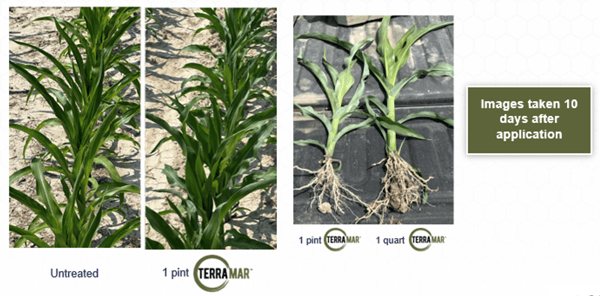
Terramar applied at 1 pint/acre at V4 (left) & at 1pint vs 1 quart (right).

8. Terramar on Corn – Bennet, NebraskaTerramar 8 Nebraska Corn 2023

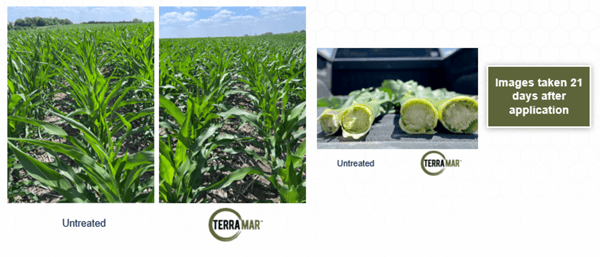
Terramar was applied at 1 pint/acre on May 30, 2023. Photo taken June 20, 2023, 21 days after Terramar application. Some leaf rolling observed on untreated corn. 86 degrees Fahrenheit.

9. Terramar on Corn – Ferris, Illinois

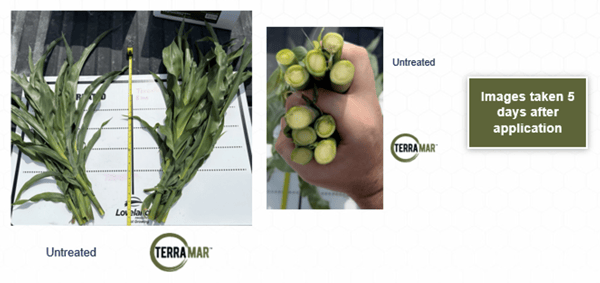
Terramar 9 Illinois Corn 2023Terramar was applied at 1 quart/acre on on June 3, 2023. Photos taken 5 days after Terramar application. Plants taken 20 rows into each block; 1 plant every 20 steps. 5 plants per bundle.

10. Terramar on Corn – Parker, South Dakota

Terramar 10 South Dakota Corn 2023

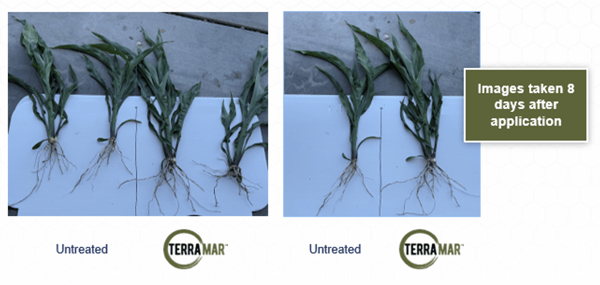
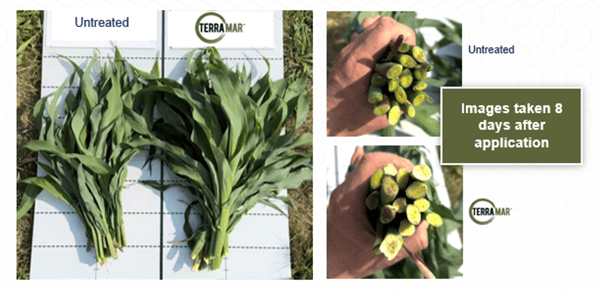
Terramar was applied at 1 quart/acre at V4 on June 7, 2023. Photos taken 8 days after Terramar application. 

*Bonus Photo* Terramar on Corn – Arcadia, Indiana

Terramar 11 Arcadia Indiana Corn 2023Terramar was applied at 1 quart/acre at V4-5.

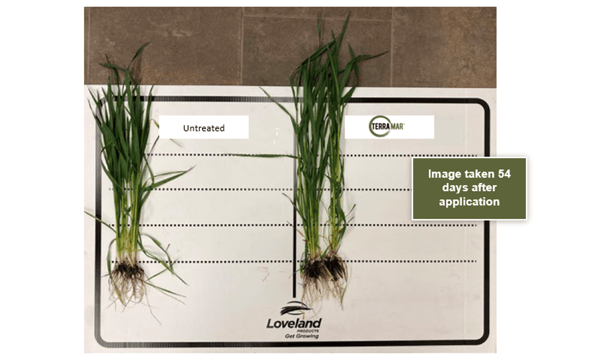
*Bonus Photo* Terramar on Wheat – Western Kansas

Terramar 12 Western Kansas Wheat 2023Terramar was applied at 1 quart/acre at first green-up (Feekes 3-4) on March 21, 2023. Cold and dry conditions. Photo taken 54 days after application.

Learn more about Terramar by downloading the Terramar row crop bulletin.

Access the Bulletin

Read More