




As yield increases, so does crop residue volume, particularly in corn. Excess post-harvest residue presents challenges on any farm, especially in reduced till or no-till environments. Come spring, three of the main issues farmers with excess residue can face are:
- Lower soil temperatures: This is particularly problematic as soybean planting dates are pushed earlier.
- Excess moisture: Residue retains moisture and can delay planting.
- Delayed emergence: Residue on top of the row of planted soybeans can decrease seed to soil contact and delay emergence.
One way to tackle this challenge is with an application of EXTRACT, which can be broadcast on crop residue in the fall after harvest or in the spring prior to planting to enhance residue decomposition. The newest version, EXTRACT XC, is concentrated for easy handling in the field.
 Tanner Evenstad (pictured on left), who farms in Belmont, Wisconsin, worked with his Loveland Products agronomist Andrew Tucker (pictured right) in the fall of 2025 to apply EXTRACT on his corn stalks as part of a residue management trial. Taking a look at his field in late April, he could see a significant difference where EXTRACT was applied.
“Where it wasn’t applied, that’s where the residue wasn’t broken down nearly as much, and it was a little bit harder to dig the seed,” Tanner explains. “You could tell that the areas treated with EXTRACT were better.”
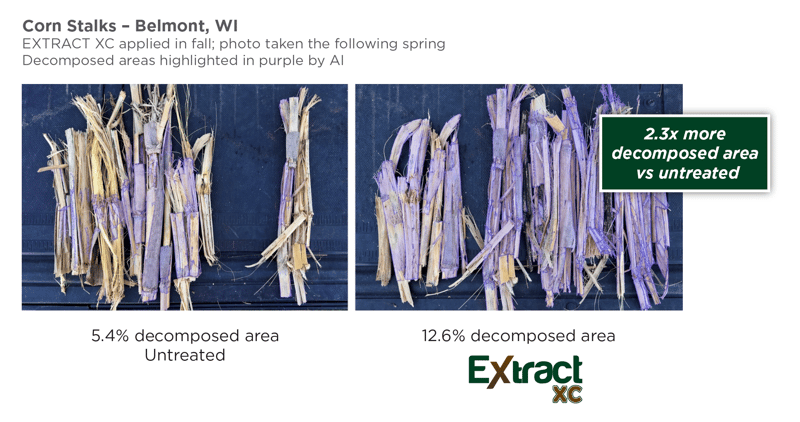
Andrew and Tanner also used AI to help them compare some of the corn stalks from the treated and untreated areas. Looking at their samples, they found that stalks pulled from the EXTRACT-treated field had 2.3x more area showing decomposition compared to untreated stalks.
For decomposition analysis, the image was converted to grayscale, then artificial intelligence (AI) was used to apply an automatic threshold to highlight decomposition-associated areas. AI detected and highlighted decomposition in 5.4% of the area in untreated stalks compared to 12.6% of the area in stalks treated with EXTRACT.
One of the advantages of EXTRACT is that the key component driving its residue breakdown capabilities is not live microbes, but rather the metabolites that microbes make naturally, which is captured during the manufacturing process. It is these metabolites that do the heavy lifting of helping to turn residue from last season into plant-available nutrients this season, while also increasing the rate of nutrient mineralization in the soil profile.
This means that farmers don’t have to wait for their soil microbes to “wake up” in the spring to start the process of residue breakdown and nutrient mineralization. Instead, EXTRACT gives them a head start, since the microbial metabolites in the product are active even under cool conditions.
This not only increases nutrient availability in the soil, it also offers the potential for earlier planting in the spring.
“We’re able to get out to the field a little bit sooner with that residue decomposition from EXTRACT,” says Andrew. "We're really looking forward to doing tissue tests in season and seeing what extra nutrients we made available for the soybean crop this year."
Learn more by downloading the EXTRACT XC product booklet.