




<img height="1" width="1" style="display:none" src="https://www.facebook.com/tr?id=301879849994395&amp;ev=PageView&amp;noscript=1">

Blog

See the latest news, innovation updates, trial results, grower stories and more from Agricen. 
June 10, 2013 — Posted By Agricen

UAN application.jpgA study published in the Journal of Environmental Quality showed that SoilBuilder, a biologically derived biochemical product, reduces nitrous oxide (N2O) emissions associated with nitrogen fertilizer applications. The study was led by researchers at Auburn University, in collaboration with USDA-ARS and Agricen Sciences, and investigated how microbial-based treatments affect nitrous oxide emissions from agricultural soils. It is one of the first studies to evaluate the use of microbial-based inoculants for the purpose of reducing nitrous oxide emissions from soil combined with common agricultural nitrogen fertilizers. 

The treatments investigated were SoilBuilder, a metabolite extract of SoilBuilder (SoilBuilder filtered - containing no microbial cells), and a mixture of four strains of plant growth-promoting Bacillus species. Experiments included two different N fertilizer treatments (urea and UAN 32%) and an unfertilized control. Nitrous oxide emissions were determined from soil incubations and analyzed with gas chromatography.

In soils fertilized with UAN, SoilBuilder reduced cumulative nitrous oxide emissions by 80% and its metabolite extract reduced emissions by 44% after 29 days of incubation. In the unfertilized treatment, SoilBuilder’s metabolite extract significantly reduced cumulative emissions of nitrous oxide by 92%. Microbial-based treatments did not reduce nitrous oxide emissions associated with urea application. Overall, the researchers concluded that microbial-based treatments can reduce nitrous oxide emissions associated with nitrogen fertilizer application, and that this response varies with the type of treatment and fertilizer.

Citation: Calvo P, Watts DB, Ames RN, Kloepper JW, Torbert HA. Microbial-Based Inoculants Impact Nitrous Oxide Emissions from an Incubated Soil Medium Containing Urea Fertilizers. J Environ Qual. 2013. doi: 10.2134/jeq2012.0300.
Read More
May 6, 2013 — Posted By Agricen

denton

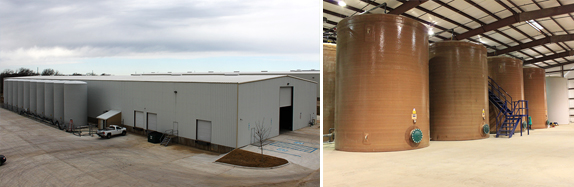
At our world-class biochemical production facility in Denton, Texas, we make some of Loveland Products’ fastest growing brands—Accomplish, Extract and Titan—as well as Agricen’s SoilBuilder, SoilLife and NutriLife brands. Completed in September 2011, the Denton plant was built to accommodate growing demands for these products, which were formerly only produced at our Pilot Point, Texas location.

At Denton, our products are produced through a patent-pending fermentation process using a new, state-of-the-art manufacturing platform. This process yields a highly concentrated extract that contains a diverse community of naturally occurring microorganisms and their biochemical byproducts (e.g., enzymes, organic acids). The end product is a biological and biochemical product that can be used as part of an integrated nutrient management program to improve plant nutrition.

Learn more about our products and their role in sustainable agriculture by downloading our Growing for the Future Booklet.

Access the Booklet

Read More
July 19, 2012 — Posted By Agricen

Plant Biology 2012 Logo

Plant scientists from the University of Kentucky will present a poster session on research involving SoilBuilder at Plant Biology 2012, the annual meeting of the American Society for Plant Biologists (ASPB):

What? Plant Biosensors: Monitoring changes in the phenlypropanoid pathway in response to microbial based soil additives (Poster 16 - Gene Regulation and Molecular Biology)
Who? Mohammad Babar Ali & David H McNear, University of Kentucky
When & Where? Plant Biology 2012, July 20-24, 2012, Austin, TX

Read More
October 14, 2011 — Posted By Agricen

Low-angle view of corn fieldAgricen presented data on SoilBuilder at the 2011 ASA, CSSA and SSSA International Annual Meetings. SoilBuilder is Agricen’s base biochemical fertilizer catalyst technology for the agriculture industry.

In a 3-year field study conducted at Arise Research and Discovery (Martinsville, IL), SoilBuilder reduced nitrate leaching from soil applications of urea ammonium nitrate (UAN) – in addition to improving nitrogen use efficiency and corn yields – when incorporated into an integrated nutrient management program on corn. The data was discussed during an oral presentation: Increased Nitrogen Use Efficiency and Reduced Nitrate Leaching Using SoilBuilder AF in an Integrated Nutrient Management Program on Corn (Abstract #387-3).

Data from a separate study on SoilBuilder, conducted by researchers from Auburn University, was also presented: Microbial Inoculants as Tools for Reducing Nitrous Oxide Emissions from Soil (Oral presentation; Abstract #288-4).

Read More
September 13, 2011 — Posted By Agricen

Reducing a fertilizer’s leachable nitrates allows the fertilizer to act more efficiently. It also helps protect our water resources.

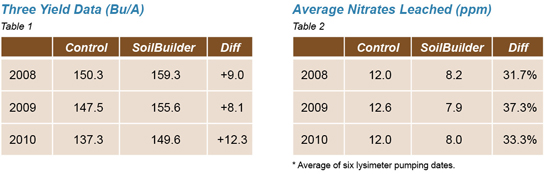
In a three-year lysimeter study, we evaluated the ability of SoilBuilder™, our base fertilizer catalyst platform, to increase corn yields by converting fertilizer nitrogen (N) into a less leachable form. The study was conducted at the field research facilities of Arise Research & Discovery, Inc., in Illinois.

SoilBuilder-treated fertilizer was compared to untreated fertilizer (control) over three growing seasons. Corn yield and nitrate leaching were evaluated. Each treated area (SoilBuilder vs. control) included four rows of field corn (row length: 30 ft; row spacing: 30 in; seed rate: 30,000/acre. The volume of leachable water and nitrate-nitrogen (NO3-N) concentrations in the water were determined six times during each season following pumping of the lysimeter wells.

In each of the three seasons, adding SoilBuilder to fertilizer increased yields over the control (Table 1). It was also associated with a significant reduction in nitrate leaching compared to the control (Table 2).

SoilBuilder - Fertilizer Increased Yields

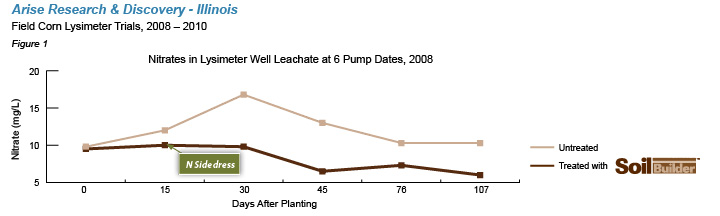
The average rate of nitrate leaching during the 2008 growing season is shown in Figure 1.

Average rate of nitrate leaching

Overall, this field trial shows the ability of SoilBuilder to convert fertilizer nitrogen into a less leachable form that is more available for crop nutrition.

It is just one of the many projects we do at Agricen to demonstrate that our biologically sourced tools can effectively increase crop yields.

Read More