




Mid- to late summer is prime time for growers to be on the lookout for fungal diseases like gray leaf spot, tar spot and southern rust in corn and septoria brown spot, white mold and frogeye leaf spot in soybeans. While fungicides are a standard and effective practice when faced with the potential for these yield-robbing diseases, an application that combines a foliar fungicide plus TERRAMAR better optimizes plant health and can protect even more yield potential.
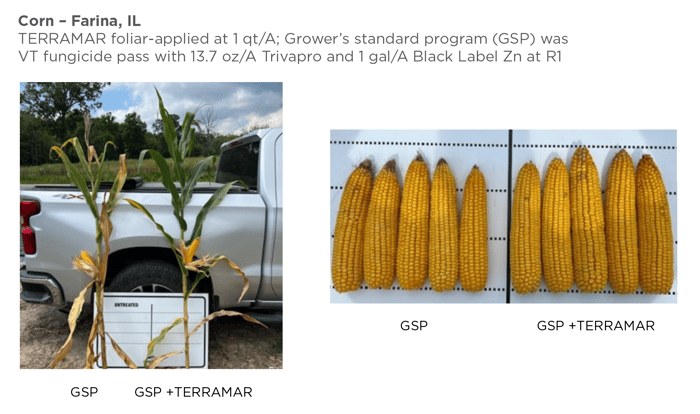
In this trial from Jefferson County, Illinois, adding TERRAMAR to the grower's standard fungicide program (GSP) at VT stage resulted in better late-season stay green and better kernel fill/test weight compared to the GSP alone.
How TERRAMAR Complements Corn and Soybean Fungicides
Fungal diseases destroy green leaf area and reduce photosynthesis, leading to less carbohydrate production and less sugar supply during grain fill /pod fill. They also cause the plant to drain or reallocate sugars to help the plant function under disease pressure, which can lead to poor kernel or pod fill and stalk cannibalization.
TERRAMAR complements the action of fungicides by enhancing photosynthesis, improving nutrient uptake and preserving valuable sucrose for grain and pod fill, while also mitigating the effects of heat-induced stress the crop may encounter.
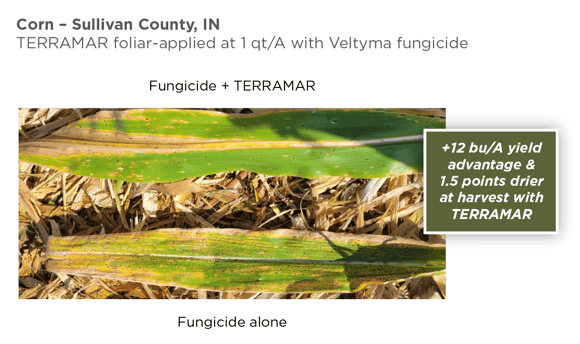
Utilizing TERRAMAR with a VT fungicide application not only improved plant health (as is visible in the larger, greener corn leaf at top), but also led to a significant yield advantage in this Indiana corn trial.
A reproductive-stage application of TERRAMAR:
- Increases photosynthetic capacity/carbon fixation → more carbohydrate production
- Enhances sucrose production, storage and utilization → more sugar supply during grain fill/pod fill; better kernel fill/pod fill
- Increases nutrient uptake and metabolic activity → more optimal plant physiological functioning
- Improves plant tolerance to heat and other abiotic stress → less stress stacking/reduces compounding effect of biotic + abiotic stress
TERRAMAR is compatible with most fungicides and crop inputs, with a standard foliar rate of 1 quart/acre. Application timing is flexible, but reproductive-stage application windows for TERRAMAR align well with fungicide timing:
- VT–R1 (most common in corn)
- R1 to R4 (soybeans)
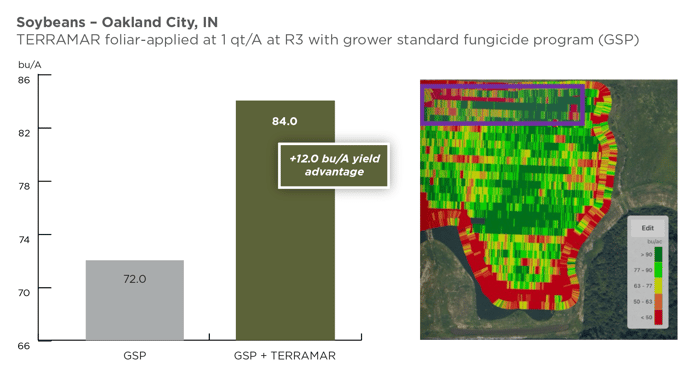
Soybeans also benefit when TERRAMAR is added to an R-stage fungicide application. In this trial from Indiana, there was a +12 bu/A yield advantage associated with adding TERRAMAR to an R3 foliar fungicide application.
Bottom line: Fungicides protect the crop, while TERRAMAR keeps the crop functioning better across a range of growing conditions. Together, they help the crop realize more of its yield potential.
Learn more by downloading the TERRAMAR + Foliar Fungicide FAQ.