


<img height="1" width="1" style="display:none" src="https://www.facebook.com/tr?id=301879849994395&amp;ev=PageView&amp;noscript=1">

Blog

See the latest news, innovation updates, trial results, grower stories and more from Agricen. 
August 11, 2026 — Posted By Agricen

08-26 TerramarMore than three million acres of row crops across America have been treated with TERRAMAR during the 2026 growing season—and new availability in both Canada and Australia means that many more growers now have access to this unique foliar technology.

In this interview with WITY Radio, Agricen’s Scott Lay discusses why TERRAMAR has been so successful and how it fits with late-season fungicide applications in corn and soybeans.

Dennis Michelsen – WITY Radio: Tell us why TERRAMAR should be in our game plan.

Scott Lay - Agricen: TERRAMAR is a very effective tool that can be used early post with herbicides, during reproductive-phase fungicide applications, or both. It has proven consistent in its ability to minimize the impact of weather-induced stress—which at this time of year is often related to heat and or drought—and in its ability to increase nutrient flow into the plant, resulting in more sucrose being made by the plant, which can ultimately lead to more yield.

Dennis – WITY Radio: It pays to take extra care, because every time the plant is in stress, that's when we lose yield.

Scott - Agricen: That's right. Anything we can do to create a more desirable environment for the crop or to optimize crop functioning, such as by improving water use efficiency, lowering canopy temperatures, or increasing the amount of photosynthesis or sugars produced—all of which TERRAMAR does—translates to the potential for greater yield when the combine rolls through the field in the fall.
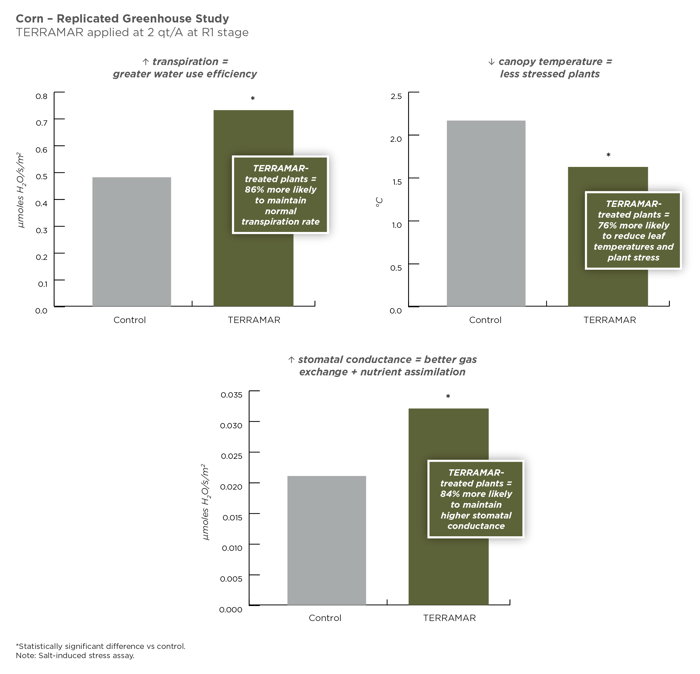
07-26 Terramar-corn

In the greenhouse study above, a foliar application of TERRAMAR improved water use efficiency,
kept plants cooler, and improved gas exchange and nutrient assimilation, all of which illustrate more optimal plant functioning that can push a crop towards a more positive yield outcome.

Dennis – WITY Radio: And TERRAMAR rides along just fine with other products that growers are applying at this time of the year.

Scott - Agricen: Yes. With the amount of precipitation and humidity we’ve had, there's been a high potential for disease presence in both corn and soybeans. A lot of growers have been making the decision to apply a fungicide to help manage the impact of disease in their crop. TERRAMAR is a great companion for that fungicide application. Obviously it doesn't control diseases because it’s not a fungicide itself, but if you can have a stronger plant with more photosynthesis and more water moving through that plant due to an application of TERRAMAR, it's a tougher environment for those diseases to expand and flourish.

Dennis – WITY Radio: How is TERRAMAR working in the field? What are the differences we notice?

Scott - Agricen: We'll start with the differences in the plants. In as little as three to five days after application, there's a noticeable difference in plant growth and in plant greening. That ties back to the photosynthesis that is occurring with greater efficiency. There's more water transpiration and more sugars surging through that plant. And that translates to a healthier, more robust plant visually.

If we transition to later in the season, even before the combines run, TERRAMAR is preserving more kernel mass in corn and soybean seed size is larger because the plant has more nutrients to fill that grain or pod. That's what translates to the yield. TERRAMAR is positively impacting the plant throughout the course of the growing season so that more yield is preserved. I think that’s really the story of TERRAMAR.

Dennis – WITY Radio: Right now, corn and soybean prices are down. The only way to do better with low prices is to grow more crop.

Scott – Agricen: The average yield advantage with TERRAMAR over hundreds of different split field trials in corn is about +7.5 bu/A. In soybeans, it’s about +4.5 bu/A. That’s for an investment of about $8 per acre for the grower. So the economics stack up favorably.

Now, commodity prices aren't where any of us would like. But we're not going to save our way to prosperity. If we make selective investments in practices that are going to provide a high likelihood of return, that's how we get ahead over time.

Dennis – WITY Radio: And it's not just about the average increase in yield. It's the percent of wins that you have in these trials.

Scott – Agricen: That’s right. There’s a strong change of a net positive economic return. We see that almost 90 percent of the time. So it seems like an investment worth making as you consider whether TERRAMAR should be a part of those summer fungicide applications.

Learn more about using TERRAMAR with fungicide applications by downloading the FAQ.


Read More
July 9, 2026 — Posted By Agricen

Mid- to late summer is prime time for growers to be on the lookout for fungal diseases like gray leaf spot, tar spot and southern rust in corn and septoria brown spot, white mold and frogeye leaf spot in soybeans. While fungicides are a standard and effective practice when faced with the potential for these yield-robbing diseases, an application that combines a foliar fungicide plus TERRAMAR better optimizes plant health and can protect even more yield potential.

Terramar fungicide corn trial illinois

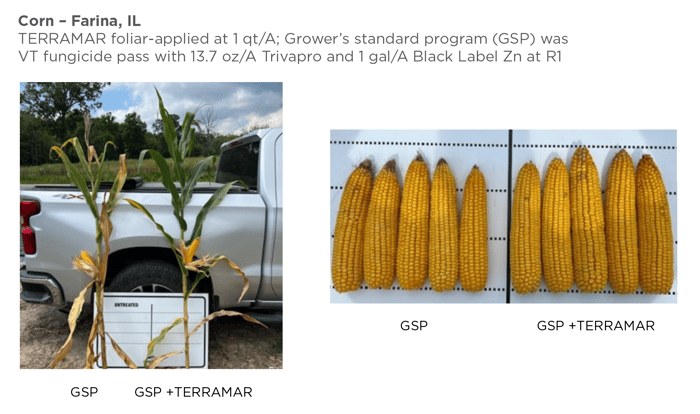
In this trial from Jefferson County, Illinois, adding TERRAMAR to the grower's standard fungicide program (GSP) at VT stage resulted in better late-season stay green and better kernel fill/test weight compared to the GSP alone.

How TERRAMAR Complements Corn and Soybean Fungicides

Fungal diseases destroy green leaf area and reduce photosynthesis, leading to less carbohydrate production and less sugar supply during grain fill /pod fill. They also cause the plant to drain or reallocate sugars to help the plant function under disease pressure, which can lead to poor kernel or pod fill and stalk cannibalization.

TERRAMAR complements the action of fungicides by enhancing photosynthesis, improving nutrient uptake and preserving valuable sucrose for grain and pod fill, while also mitigating the effects of heat-induced stress the crop may encounter.

Terramar fungicide corn trial Indiana

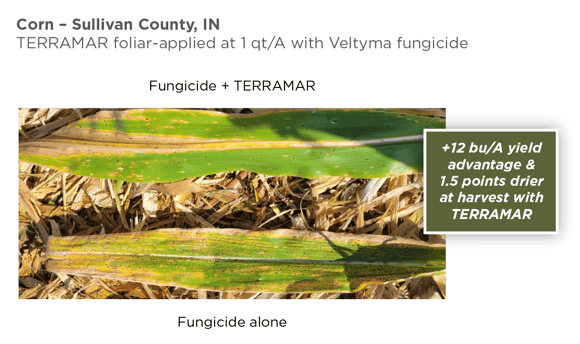
Utilizing TERRAMAR with a VT fungicide application not only improved plant health (as is visible in the larger, greener corn leaf at top), but also led to a significant yield advantage in this Indiana corn trial.

A reproductive-stage application of TERRAMAR:

  • Increases photosynthetic capacity/carbon fixation → more carbohydrate production
  • Enhances sucrose production, storage and utilization → more sugar supply during grain fill/pod fill; better kernel fill/pod fill
  • Increases nutrient uptake and metabolic activity → more optimal plant physiological functioning
  • Improves plant tolerance to heat and other abiotic stress → less stress stacking/reduces compounding effect of biotic + abiotic stress

TERRAMAR is compatible with most fungicides and crop inputs, with a standard foliar rate of 1 quart/acre. Application timing is flexible, but reproductive-stage application windows for TERRAMAR align well with fungicide timing:

  • VT–R1 (most common in corn)
  • R1 to R4 (soybeans)

Terramar soybean fungicide trial Indiana

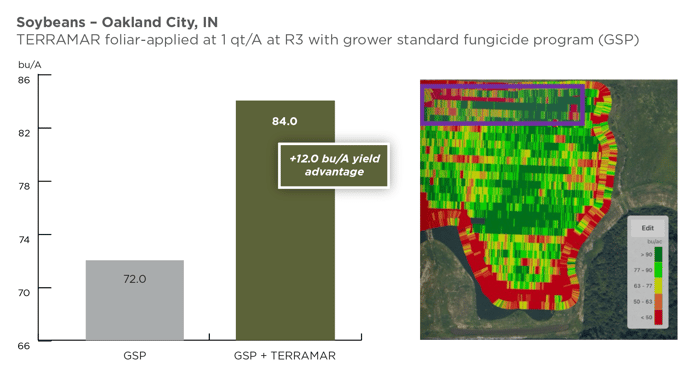
Soybeans also benefit when TERRAMAR is added to an R-stage fungicide application. In this trial from Indiana, there was a +12 bu/A yield advantage associated with adding TERRAMAR to an R3 foliar fungicide application.

Bottom line: Fungicides protect the crop, while TERRAMAR keeps the crop functioning better across a range of growing conditions. Together, they help the crop realize more of its yield potential.

Learn more by downloading the TERRAMAR + Foliar Fungicide FAQ.


Read More
July 2, 2026 — Posted By Agricen

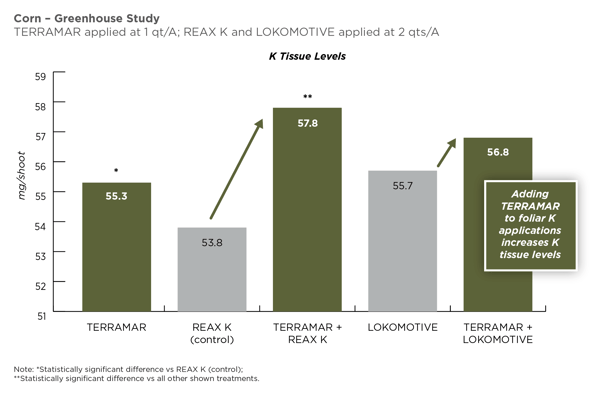
When TERRAMAR is applied to a crop, one well known benefit is greater plant uptake of nutrients, including potassium (K). This not only applies to uptake of K from the soil, but also to uptake of K that is foliar applied during the season. TERRAMAR serves as a booster, getting more K into the plant when applied with foliar K products.

The greenhouse study below shows how adding TERRAMAR to a foliar K product like LoKomotive or Reax K can impact K tissue levels in the plant. There was a synergistic effect when TERRAMAR was applied with each foliar K product, leading to greater uptake of this critical nutrient than with any foliar K product alone.

Corn-Terramar-ReaxK-Lokomotive-Potassium

TERRAMAR is also a good fit with foliar K applications as well as with other in-season foliar applications a grower may be making (including herbicides and fungicides) because it is known to increase a plant's photosynthetic capacity, enhance sucrose storage and utilization, improve the crop's overall physiological functioning and mitigate the effects of abiotic stress, all of which helps build a stronger plant and preserve yield potential throughout the season.

Summary of TERRAMAR's Key Benefits:

  • Improves nutrient uptake efficiency (including K uptake)

  • Builds photosynthetic capacity resulting in a larger, more robust plant with increased sucrose storage

  • Preserves plant sucrose reserves by improving physiological functioning, leading to more sucrose availability at grain fill

  • Mitigates the impact of abiotic stresses like heat or dry conditions

Bottom line: Addressing K levels in the plant, particularly in K-limited soils, is a challenge. Making an in-season foliar K application is a solid agronomic approach that can be enhanced with the addition of TERRAMAR. Given that K is often a yield-limiting factor, utilizing TERRAMAR with a foliar K product can set the crop up for higher yield.

Learn more about TERRAMAR by downloading the TERRAMAR with foliar K study.

Read More
May 27, 2025 — Posted By Agricen

05-25-foliar-webinar-landing-pgHow do in-season foliar applications help crops achieve or preserve their yield potential? 

Watch our on-demand webinar, "Preserving Yield Potential with Proactive Foliar Applications," to learn:

  • How foliar applications help growers preserve yield potential
  • How foliar-applied TERRAMAR increases nutrient uptake and minimizes the potential impact of weather-related stress in a broad range of crops
  • Details from Advanced Agrilytics' on-farm trials testing early post applications of TERRAMAR on corn

Guest speaker AJ Woodyard, the research agronomy lead for Ag Ingenuity Partners (the independent research arm of Advanced Agrilytics), presents some of the key findings from TERRAMAR corn trials conducted by Advanced Agrilytics during the 2024 season. Key takeaways from the trials, in which a V6 foliar application of TERRAMAR was evaluated on ten farms across Iowa, Illinois, Indiana and Ohio and compared to a control, include increased crop uptake of nitrogen and phosphorus, increased sucrose concentration in the plant and yield benefits in both water-limited and stable environments where TERRAMAR was applied.

A combination of two unique technologies, TERRAMAR delivers increased nutrient uptake and enhanced stress mitigation, which can optimize plant health and contribute to enhanced yield. The carbon-based technology (CBT) in TERRAMAR, which is derived from biologically converted leonardite, enhances nutrient uptake and photosynthetic capacity, providing key carbon derivatives for additional energy to optimize plant performance. This is complemented by TERRAMAR's marine-based technology (MBT), a formulation of biologically extracted kelp, which improves crop tolerance to abiotic stresses such as heat, cold, dry conditions and salt.

Multiple field trials validate the effectiveness of TERRAMAR as an in-season addition to foliar nutritional or crop protection programs in a wide variety of crops, including corn, soybeans, wheat, grain sorghum, cotton, alfalfa, lettuce, onions, potatoes and sugarcane.

TERRAMAR is available from Loveland Products through Nutrien Ag Solutions

Watch the webinar today to learn how TERRAMAR can help preserve yield potential through improved crop nutrient uptake and enhanced abiotic stress tolerance.

Read More
March 5, 2024 — Posted By Agricen

TERRAMAR can be applied to a wide variety of row crops, including corn, soybeans, wheat, grain sorghum (milo) and cotton. In this blog, we answer common questions about using TERRMAR in row crop programs.

What is TERRAMAR?
TERRAMAR is a foliar-applied product that combines a biologically converted kelp source and biologically converted leonardite, which is a carbon source. It is intended for foliar applications in row crops at vegetative and reproductive stages.

What does TERRAMAR do?

TERRAMAR improves nutrient uptake efficiency and enhances stress mitigation, optimizing plant health and contributing to enhanced yield. The two technologies in TERRAMAR stimulate plant development, increase photosynthetic capacity and help the plant maintain more optimal physiological functioning, translating into more consistent plant performance across a broad range of growing environments.

Why use TERRAMAR in row crops?
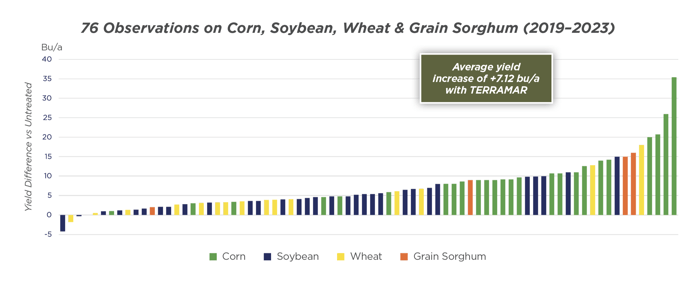
TERRAMAR is formulated to increase nutrient uptake and enhance stress mitigation, which can optimize plant health and contribute to enhanced yield. In 76 trials conducted from 2019 to 2023 across corn, soybeans, wheat and grain sorghum, TERRAMAR offered an average yield advantage of +7.12 bu/acre compared to untreated check.

Terramar-piano_graph 2019-2023

What are the key benefits of TERRAMAR for row crops?
TERRAMAR sets a new standard in stress mitigation and plant performance. Foliar application of TERRAMAR improves abiotic stress tolerance (e.g. heat, cold, drought) at various stages of plant growth. Visible improvements in stressed crops can often be observed several days after application. Additionally, increased nutrient use efficiency has been documented with TERRAMAR, as well as enhanced sucrose storage and utilization, which can lead to better grain fill and crop yield.

How and when should TERRAMAR be applied?
TERRAMAR can be foliar-applied in early post-emergent applications as well as mid- to late-season fungicide applications to enhance plant performance while minimizing weather-induced stress. It fits well with in-season applications of foliar nutrients (e.g., foliar K), plant growth regulators and herbicide/ fungicide applications. The recommended rate of TERRAMAR is 1 quart per acre.

Should I apply TERRAMAR even if I am not anticipating severe crop stress?
Yes. TERRAMAR can optimize plant performance in all growing conditions, whether stressful (in which crop development could be impacted) or average to ideal.

Learn more by downloading the TERRAMAR Product Booklet.


Read More
May 24, 2023 — Posted By Agricen

Terramar Webinar

How can growers mitigate the effects of weather-related crop stresses like heat and dry conditions while also increasing nutrient uptake by their crops during the growing season?

Watch our on-demand webinar, "Introducing Terramar: A New Way to Help Row Crops Stand Up to Stress," to hear:

  • How Terramar improves crop tolerance to abiotic stresses while enhancing nutrient uptake

  • Why Terramar is a good fit for any row crop program, including corn, soybean, and wheat

  • Details about application timing, trial results, and more

Intended for foliar use in row crops, Terramar delivers increased nutrient uptake and enhanced stress mitigation to optimize plant health and contribute to enhanced yield.

Terramar combines two unique technology platforms with complimentary functions to improve plant performance and help crops "Stand Up to Stress":

  • Carbon-Based Technology, or CBT. CBT is derived from biologically converted leonardite, a carbon source. CBT enhances nutrient uptake and provides key carbon derivatives for additional energy to optimize plant performance

  • Marine-Based Technology, or MBT. MBT is derived from biologically converted kelp. MBT improves crop tolerance to abiotic stressors such as heat, drought, salt, and cold, which can represent significant yield-limiting factors.

Terramar is compatible with key crop inputs, including foliar nutrition, insecticides, herbicides, and fungicides, for maximum application flexibility. Multiple field trials validate the effectiveness of Terramar as an addition to crop protection (herbicide, insecticide or fungicide) and nutritional programs.

Terramar can be used in combination with early, mid-season, or late-season foliar applications to mitigate stress and improve nutrient uptake. Foliar applications deliver its unique set of highly active, metabolite-based compounds for quick absorption through the leaf tissue of the plant.

Terramar is exclusively available from Nutrien Ag Solutions.

Watch the webinar today to learn how Terramar can help row crops stand up to stress.

Watch the Webinar


Read More
March 6, 2017 — Posted By Agricen
Read this Q&A for a brief introduction to IBA, kinetin and other compounds that aid in plant growth and functioning—and learn how they can help optimize plant performance.

foliar

What are IBA and kinetin, and how do they benefit crops?

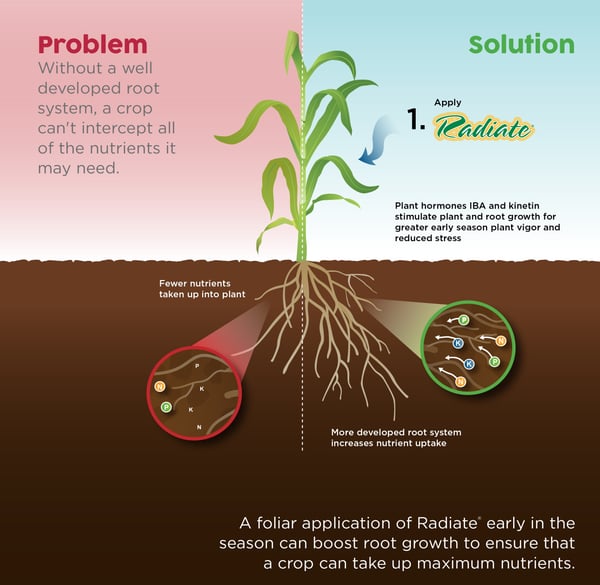
IBA (which stands for indolebutyric acid) and kinetin are two different types of plant growth regulators or hormones. IBA is an auxin that is produced in the plant’s leaves and shoots. IBA travels downwards to the roots and stimulates early and improved root growth, which increases plant vigor and the plant’s ability to fight off stress throughout the growing season. Kinetin is a cytokinin that travels up the plant from the root tips, directing many physiological functions of plant growth.

IBA and kinetin (as cytokinin) are the active ingredients in Radiate®, which combines these two plant growth regulators in the optimum ratio to maximize the physiological processes in the plant that drive root and shoot growth. Radiate is designed to help crops develop longer, stronger, healthier roots to improve nutrient uptake. It can be used as a foliar application during the two- to six-leaf growth period (V2-V6) to jumpstart early season root growth and plant vigor, which can lead to gains in crop productivity. 

Browse Agricen's Collection of Resources

foliar-technologies-radiate-roots

What is NutriSync® technology, and why is it important for plant health and performance?  

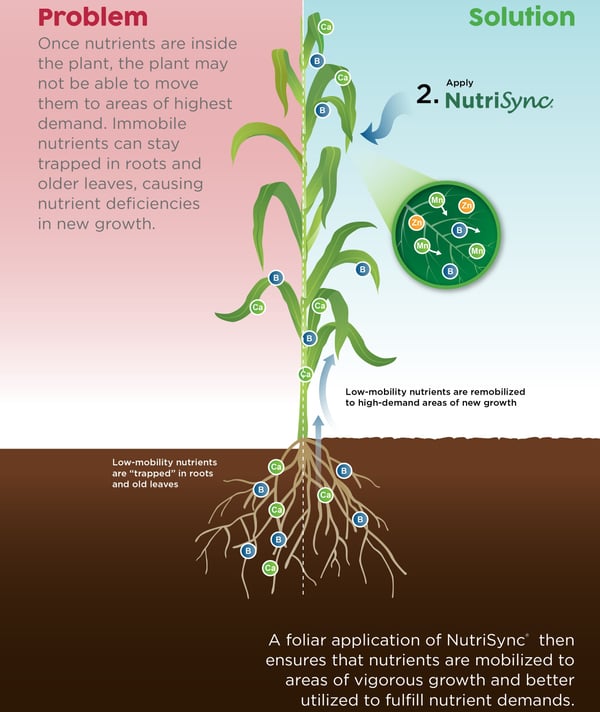
NutriSync® technology is based on a naturally occurring compound that transports and remobilizes nutrients to areas of peak demand within the plant. By providing better uptake and utilization of important nutrients and delivering them to the new points of growth in the plant, this technology helps to increase overall plant performance. 

NutriSync technology promotes nutrient mobilization to areas of high demand and supports better utilization of nutrients within the plant. These features create healthier plants throughout the growing season, which can lead to higher yields and a better return on investment. 

foliar-technologies-nutrisync

What synergies could I expect when using Radiate, which contains IBA and kinetin, with the technology found in NutriSync?  

As IBA and kinetin increase root growth and development, the plant’s ability to take up soil nutrients increases. After the nutrients are in the plant, NutriSync technology helps the plant move them to areas of new growth, where demand is highest. By using Radiate and NutriSync products together in the same season, growers can expect better root development, more efficient use of nutrients, stronger overall plant performance and an excellent return on investment. 
Radiate and NutriSync are registered trademarks of Loveland Products, Inc. Radiate is not registered in California, and is not approved or intended to be used or sold in California.

Browse Agricen's collection of resources, which includes product studies, publications, videos and infographics.

View Resources

Read More